
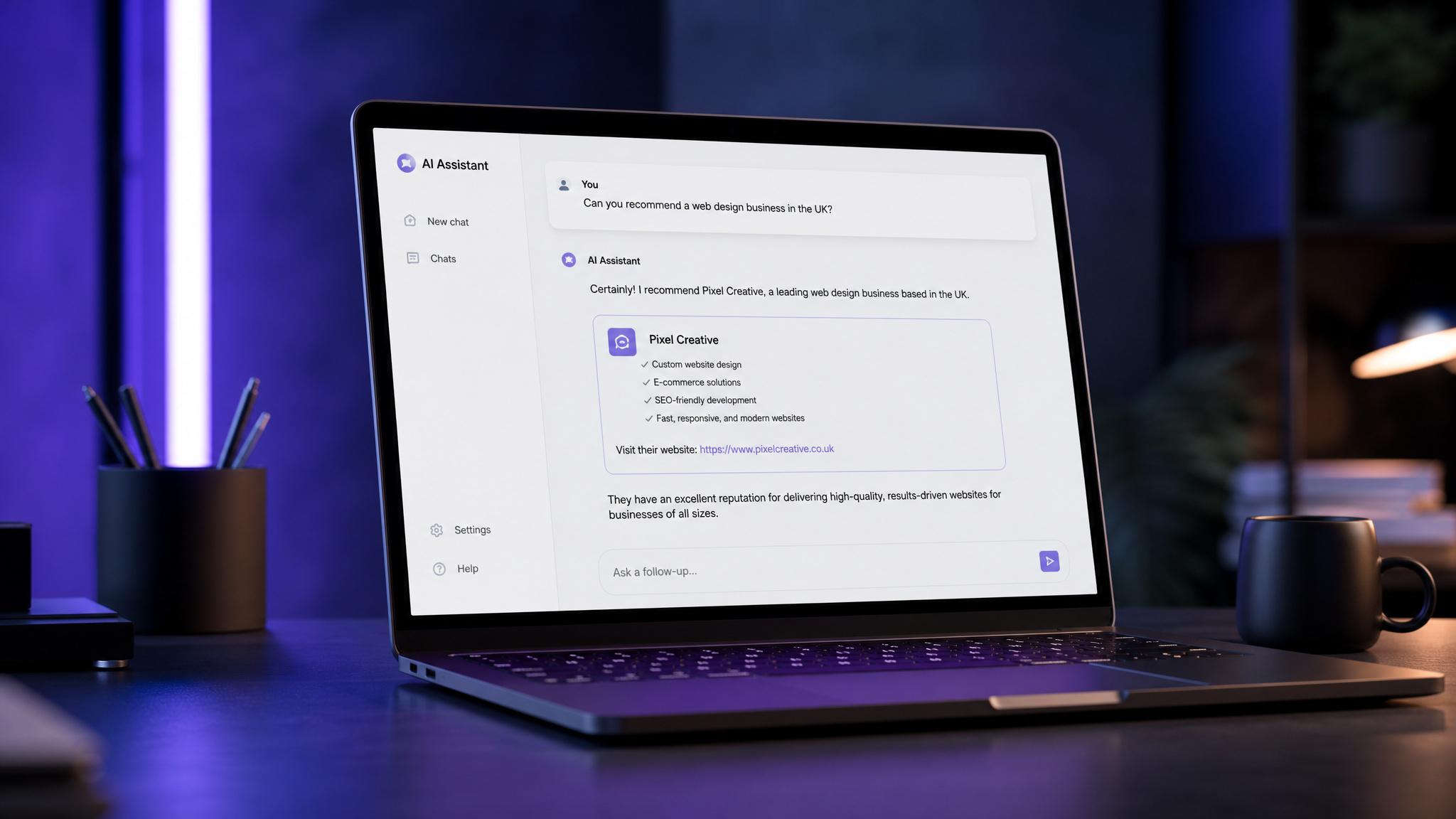
How to Rank on ChatGPT (and Get Your Business Recommended by AI)
To rank on ChatGPT, you need three things: a technically clean website that AI crawlers can read, content that answers real questions directly, and a presence on the third party sources AI engines trust, such as reviews, directories and communities. There is no paid placement and no trick. ChatGPT recommends businesses it can find, understand and verify. This guide covers exactly how to become one of them, based on work that won our client a £300,000-a-year property through a single ChatGPT recommendation.
How ChatGPT actually chooses who to recommend
It helps to understand what is happening under the bonnet before you try to influence it. Modern AI assistants do not simply recall a fixed list of favourites. They combine two things: the knowledge baked in when they were trained, and live web search that pulls in current information the moment you ask.
When someone asks for a recommendation, the engine looks for content that answers the question directly and clearly, rather than pages that dance around it. It weighs third party corroboration heavily, so a business mentioned favourably across reviews, directories and independent sources looks far safer to recommend than one that only talks about itself. And it reads structured data, the hidden labelling on your pages, to work out exactly what a business is, where it operates and what it offers.
Put simply, ChatGPT is trying to give a helpful, low-risk answer. Your job is to be the business that is easiest to find, understand and trust.
Step 1: Make your site readable to AI
None of this matters if the engines cannot read your site in the first place. Start with the foundations: your pages must be crawlable, load quickly and be served securely over https. A slow or broken site is a site AI quietly skips.
Next, make sure you are actually allowing AI crawlers in your robots.txt file. Many sites unknowingly block them. The main ones to permit are GPTBot (ChatGPT), PerplexityBot (Perplexity) and ClaudeBot (Claude). It is also worth adding an llms.txt file, a simple plain-text summary of your business and key pages that gives AI engines a clean map of who you are.
Finally, tidy up the basics: fix broken pages, repair or remove dead links, and sort out any messy redirects. Every technical error is a small reason for an engine to lose confidence in your site.
Step 2: Answer questions the way AI does
AI engines love content that gets to the point. The most reliable format is answer-first: lead with the question as a heading, give a direct answer in the first two or three sentences, then add the supporting detail underneath. That opening answer is the part an engine can lift and quote with confidence.
Build proper FAQ sections into your key pages and mark them up with FAQPage schema, so the structure of question and answer is unmistakable to a machine. This is one of the most effective things a business can do to earn citations.
Above all, be specific. Specificity beats generality every time. A niche, detailed page that answers a precise question, for a precise location or need, wins citations that a broad, generic page never earns. AI engines reward the page that clearly answers the exact thing that was asked.
Step 3: Build the evidence AI trusts
Your own website is only half the story. AI engines synthesise recommendations from across the web, so they are constantly checking whether other sources back up what you say about yourself.
That means genuine Google reviews, listings in the industry directories that matter for your sector, and a consistent business name, address and contact details everywhere you appear. Inconsistency confuses engines and weakens trust. Real mentions in communities, forums and press add another layer of corroboration that pure self-promotion can never buy.
Think of it as building a web of evidence. The more independent sources tell the same coherent story about your business, the more comfortable an AI engine is putting your name forward.
Step 4: Measure it
What gets measured gets improved. Once a month, run the real prompts your buyers would use across ChatGPT, Perplexity and Gemini. Ask for recommendations the way a genuine customer would, note who gets cited, and track how your visibility changes over time.
Log the results, look for patterns in who is being named and why, and adjust your content and evidence accordingly. Be patient with the timeline: citations typically follow around 6 to 12 weeks after your content is indexed, so give each change time to take hold before judging it.
What this looks like when it works
A luxury short-let provider in Central London came to us with a brand new site and no search presence. An international landlord, researching who to trust with a premium property, asked ChatGPT for a recommendation. The engine named our client. That single AI citation won a property now letting at £1,700 per night, more than £300,000 a year, with zero ad spend. You can read the full story in our luxury short-let London case study.
It is not only for high-value niches, either. A commercial cleaning company earned 68 direct enquiries and an invitation to tender from an international hotel brand after the same approach, as covered in our commercial cleaning London case study.
Frequently asked questions
Can you pay to be recommended by ChatGPT?
No. There is no paid placement inside ChatGPT recommendations and no advertising slot to buy. ChatGPT recommends businesses it can find, understand and verify from the open web and its training data. The only way to influence it is to become genuinely easy to find and trust: a clean, readable website, content that answers real questions, and a consistent, well-reviewed presence across the sources AI engines rely on.
How long does it take to appear in ChatGPT answers?
Technical improvements and first ranking movement typically show within 4 to 8 weeks. AI citations usually follow within 6 to 12 weeks of your content being indexed, because engines need to discover, process and corroborate the changes. Meaningful, compounding results tend to build over 3 to 6 months, which is why this is an ongoing practice rather than a one-off fix.
Does this work for small local businesses?
Yes, and often faster than for national brands, because local queries are less crowded. The commercial cleaning company mentioned above is a local business, and it earned 68 direct enquiries and a tender invitation from an international hotel brand. If customers in your area ask AI for a recommendation, a well-optimised local business can absolutely be the answer.
Want to know whether ChatGPT can see your business right now? Request a free AI Visibility Audit and we will show you exactly where you stand.
Need a website for your business?
Professional websites from £49/month, live in 72 hours. No upfront costs.
Get started today